
Echoes of Principle: De La Espriella's Journey Through Law, Media, and Political Ambition
Unpack Abelardo De La Espriella's political pivot. How do a lawyer's past defenses shape a presidential bid? A deep dive into public perception and the 'coherence' challenge.
The Collision of Worlds: Law, Media, and Politics
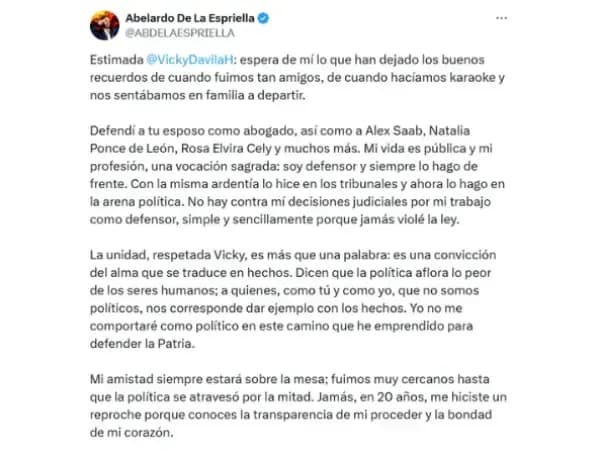
Abelardo De La Espriella's journey from a prominent, often controversial, defense lawyer to a presidential hopeful has undeniably thrown him into a swirling vortex where the distinct realms of law, media, and politics collide. This dramatic pivot immediately triggered intense public scrutiny, perhaps most notably exemplified by his recent public exchange with journalist . Their confrontation wasn't merely a political spat; it was a deeply personal and professional clash, highlighting the inherent tension between their respective vocations. Dávila, a journalist who has spent her career exposing corruption and crime, directly challenged De La Espriella, whose professional duty has been to defend individuals, regardless of their public perception or alleged wrongdoing. De La Espriella, for his part, sees his legal practice as a "sacred vocation," a public life lived "de frente" (head-on). Yet, this very public life, previously confined to courtrooms, now faces the unforgiving glare of political ambition, forcing a re-evaluation of past actions in a new, more demanding light. He even mused about their past friendship, now seemingly overshadowed by the political divide, underscoring the high stakes of this new arena.
The Advocate's Paradox: Duty Versus Public Perception
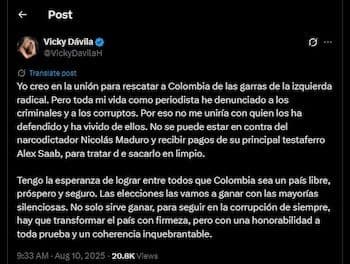
At the heart of the ongoing debate surrounding 's political aspirations lies a fundamental paradox: the ethical duty of a defense attorney versus the moral expectations placed upon a presidential candidate. didn't mince words, directly questioning how De La Espriella could oppose figures like while simultaneously defending Maduro's alleged financial frontman, . "You, Abelardo, in your profession have defended them," Dávila asserted, contrasting her role in denouncing criminals with his. This isn't just about a specific case; it's about the perceived 'coherence' of a public figure. While De La Espriella correctly points out that his legal work, which includes defending diverse clients from Álex Saab to and even Dávila's own husband, is a "sacred vocation," the political sphere demands a different kind of alignment. He insists he won't "behave like a politician" on his new path, aiming to defend the nation with the same fervor he showed in court. However, the public often struggles to separate the lawyer from the man, conflating professional obligation with personal endorsement, thereby creating a unique challenge for his political brand.
Beyond the Courtroom: A Political Ascent Under Scrutiny
De La Espriella's transition from the hallowed halls of justice to the rough-and-tumble world of presidential politics means his past legal triumphs and controversies are no longer confined to legal journals; they are now prime fodder for public debate and political attack. His defense of , described by as a "criminal linked to ", serves as a particularly potent example. What was once a professional engagement, albeit a high-profile one, transforms into a significant political liability. Dávila's pointed query, "Is he another criminal, what does defending him mean?" and her observation that "money is not everything" when eyeing the presidency, underscore the public's inherent skepticism. Voters often struggle to reconcile a lawyer's professional duty to represent any client with the expectation that a political leader embodies unblemished moral standing and ideological consistency. De La Espriella views his political foray as a continuation of his "ardentía" – the same passion he brought to tribunals, now directed at defending the nation. Yet, the political arena demands not just legal acumen, but a narrative of consistent principle that his past, by its very nature, complicates.
Redefining 'Coherence': A National Dialogue
The public spat between and has ignited a vital national conversation about what 'coherence' truly means for a political leader. Dávila's impassioned plea, "citizens cannot be fooled," emphasizes that consistency in principles, not just professional conduct, is paramount for those seeking the highest office. Her deeply personal reflection on wanting to "look my children in the eyes and… myself in the mirror without vomiting" encapsulates the profound moral accountability she believes public service demands. This isn't merely about legal ethics; it's about the broader societal expectation that political leaders embody an integrity that transcends their professional past. For De La Espriella, this intense scrutiny is, perhaps, an unwelcome byproduct of venturing into politics, a realm he suggests has intruded upon once-cordial relationships. The exchange forces the electorate to grapple with complex questions: Can a lawyer, whose professional duty is to represent all, credibly lead a nation? How much should a candidate's past professional choices dictate their perceived moral fitness for office? This ongoing dialogue will undoubtedly shape how voters evaluate not just De La Espriella, but future political hopefuls emerging from diverse professional backgrounds.
Related Articles
The Adult's Game: Rodrigo Pacheco's Crossroads and Brazil's Shifting Power Dynamics
The Adult's Game: Rodrigo Pacheco's Crossroads and Brazil's Shifting Power Dynamics
The Candid Confession: Anandasangaree's Dilemma Between Policy and Principle
The Candid Confession: Anandasangaree's Dilemma Between Policy and Principle
From Academia to Aftermath: Zulima Pérez's Blueprint for Resilience
From Academia to Aftermath: Zulima Pérez's Blueprint for Resilience
Unmasking the Digital Battleground: Mariya Pogrebnyak and the Shifting Sands of Celebrity Loyalty