
African Cocoa and Coffee Farmers Face EU Market Exclusion Over EUDR Compliance
COCEFAAA warns up to 40% of African cocoa and coffee smallholders could face EU market exclusion by year-end 2026 due to EUDR digital mapping and compliance costs.

COCEFAAA Issues Market Access Warning in Lagos
A significant share of African smallholder agricultural producers faces severe market access challenges under European regulatory requirements. The Cocoa and Coffee Farmers Alliance Association of Africa (COCEFAAA) warned that up to 40 percent of African smallholder cocoa and coffee farmers could be excluded from the European Union market by the end of 2026.
The warning was formally issued by COCEFAAA Global President Adeola Adegoke at the conclusion of the 2026 Africa Cocoa and Coffee Conference, held in Lagos, Nigeria. Addressing the gathering of commodity stakeholders, Adegoke highlighted the mounting risk facing small-scale producers who supply key international agricultural supply chains, noting that current compliance benchmarks present immediate obstacles for nearly half of the continent's smallholder base.
Geolocation and Digital Mapping Roadblocks
The potential exclusion stems directly from the implementation benchmarks set under the European Union Deforestation Regulation (EUDR). Central to the compliance difficulties is the requirement for digital farm-mapping systems, specifically precise farm-level geolocation data.
According to COCEFAAA, African smallholder cocoa and coffee producers currently face an acute shortage of digital farm-mapping infrastructure. Smallholder farmers broadly lack the digital tools and systems necessary to map their farm boundaries and provide the verifiable geolocation points demanded under EUDR rules. Without established digital farm-mapping architectures, verifying that commodity parcels meet the required deforestation standards becomes a major barrier to trade.
Technological Costs and Documentation Demands
Beyond digital mapping infrastructure, the alliance pointed to broader economic and administrative hurdles. High technological costs remain a primary impediment preventing smallholders from achieving compliance independently.
The EUDR requires comprehensive documentation and traceability standards that many smallholders are currently unable to generate or maintain. Adeola Adegoke underscored that the inability to absorb these high technology costs, combined with a widespread deficit in verifiable regulatory documentation, severely impedes compliance. As a result, the financial compliance standards and documentation benchmarks established under the regulation threaten to shut out small-scale producers unable to bridge the technical divide ahead of the year-end 2026 timeline.
Related Articles
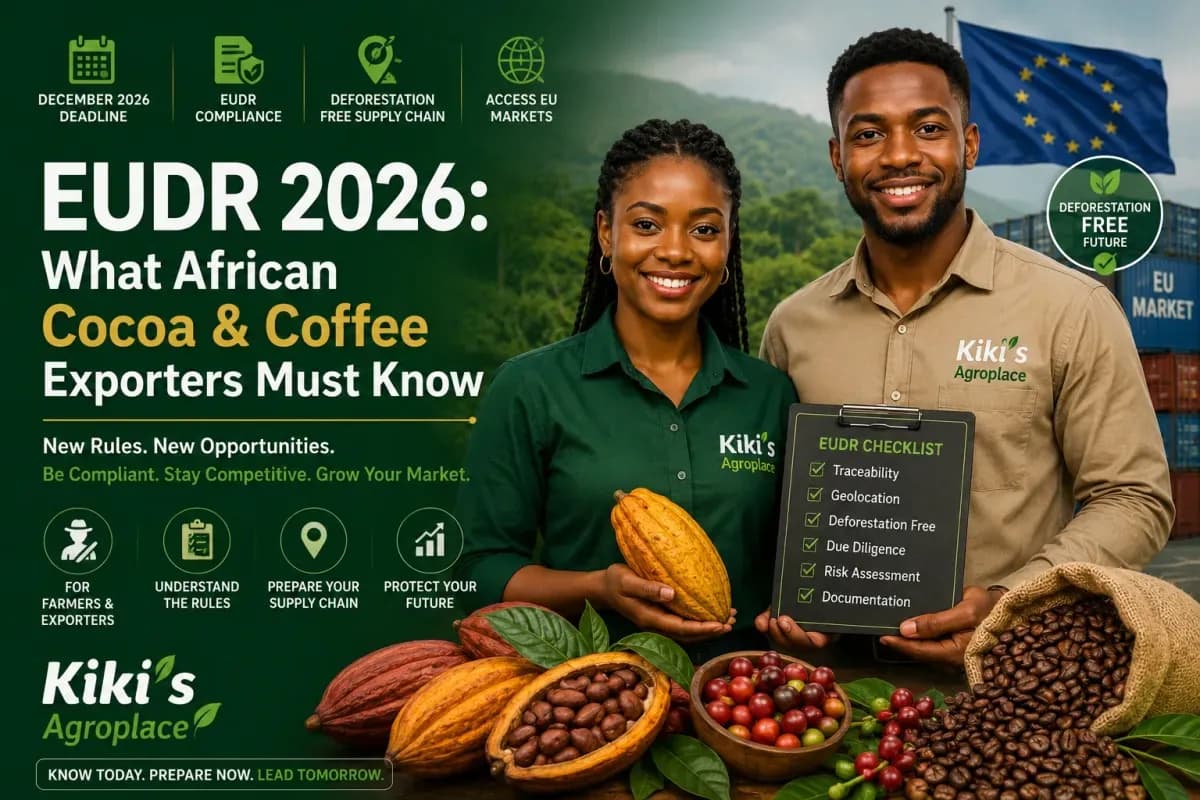
African Cocoa and Coffee Producers Face Severe EU Market Exclusion Risks Under EUDR
African Cocoa and Coffee Producers Face Severe EU Market Exclusion Risks Under EUDR

African Cocoa and Coffee Exporters Face Potential EU Market Exclusion Under EUDR Compliance Pressures
African Cocoa and Coffee Exporters Face Potential EU Market Exclusion Under EUDR Compliance Pressures
EU Agri-Food Trade: Tropical Commodity Import Values Fall 19% Amid Lower Cocoa Prices
EU Agri-Food Trade: Tropical Commodity Import Values Fall 19% Amid Lower Cocoa Prices

EIB and FCMB Announce €85 Million Agricultural Financing Facility in Nigeria