
USDA November WASDE Report Tightens Corn and Soybean Balance Sheets, Spurring Futures Rally
The USDA November 2026 WASDE report cut U.S. corn production to 15.9 billion bushels and lowered soybean ending stocks to 300 million bushels, driving sharp rallies across corn and soybean futures.
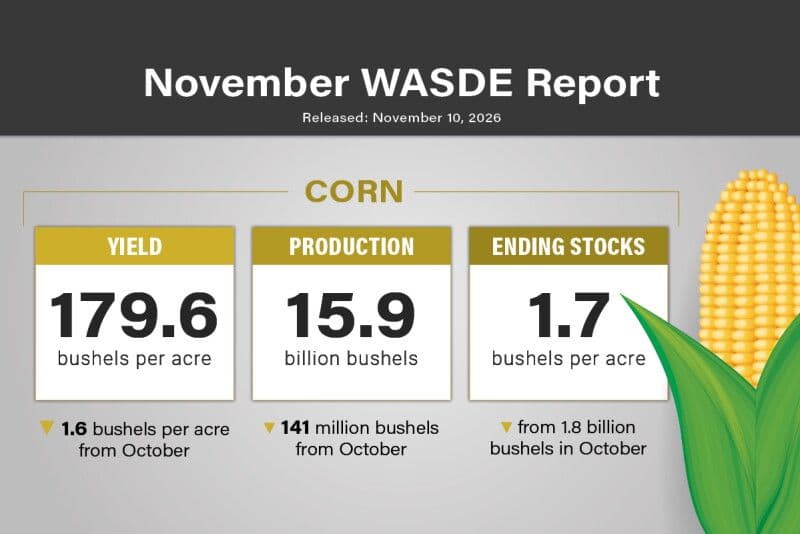
Supply Outlook Tightens in November WASDE Release
The release of the November 2026 World Agricultural Supply and Demand Estimates (WASDE) report by the United States Department of Agriculture (USDA) delivered unexpected revisions to key crop balance sheets for the 2026/27 marketing year. Market participants across international agricultural supply chains were presented with a tighter-than-anticipated supply outlook, defined primarily by downward adjustments to domestic United States corn yields and a downward revision to projected soybean ending stocks.
Prior to the release, commercial agricultural operators and commodity procurement desks were closely monitoring supply-demand balances for indications of export availability and ending inventory buffers. The resulting figures published in the November update altered baseline assumptions for global grain markets, prompting immediate reassessments of availability and procurement strategies across the sector.
Corn Production Forecasts and Yield Reductions
In the corn complex, the USDA implemented a notable downward adjustment to the 2026/27 production outlook. The department lowered the overall U.S. corn production forecast by 141 million bushels, bringing the aggregate domestic production total to 15.9 billion bushels.
The contraction in aggregate output was driven directly by field performance metrics across the growing regions. According to the report, the national average corn yield was reduced by 1.6 bushels per acre, settling at 179.6 bushels per acre. This downward adjustment to yield expectations curtailed total volume projections, directly impacting balance sheet fundamentals for the 2026/27 marketing year and tightening the domestic availability profile.
Soybean Balance Sheet Pressured by Heightened Export Demand
Adjustments within the oilseed sector also contributed to market firmness. U.S. soybean ending stocks were revised lower by 15 million bushels, which brought the projected carryout down to 300 million bushels.
This drawdown in ending stocks was primarily spurred by heightened international demand projections. The USDA increased its export forecast for U.S. soybeans by 25 million bushels. The expanded export pace absorbed a greater share of available supplies, reducing the projected inventory buffer entering the close of the 2026/27 marketing window and highlighting robust demand parameters in the international trade arena.
Futures Markets Rally on Unexpectedly Tight Data
The reaction across agricultural commodity exchanges was swift as commercial participants and traders absorbed the tighter balance sheet fundamentals. Following the publication of the report, both corn and soybean futures experienced sharp upward momentum.
Corn futures posted a surge of approximately 10 cents per bushel following the unexpected production and yield cut. Meanwhile, soybean futures registered even sharper gains, advancing by more than 30 to 40 cents per bushel. The pronounced price rally reflected the market's rapid repricing of available supply reserves in light of reduced ending stocks and a constricted production footprint.
Related Articles
Grain Markets Position Ahead of October USDA WASDE Report
Grain Markets Position Ahead of October USDA WASDE Report

Global Rice Prices Consolidate at Elevated Floor Following October Rally
Global Rice Prices Consolidate at Elevated Floor Following October Rally
Global Food Commodity Prices Reach Highest Level Since 2022 Amid Freight and Weather Pressures
Global Food Commodity Prices Reach Highest Level Since 2022 Amid Freight and Weather Pressures

Global Rice Trade Faces Heightened Volatility as El Niño Strains Asian Production